
Has “tooth exposure” been recommended for your child?
Tooth exposures are a great example of how different specialties can work together to get a great outcome for complex cases.
We took a number of images throughout a case to help explain the process.
First, let’s learn a little more about what is involved in tooth exposure treatment:
When is exposure treatment recommended?
Sometimes due to abnormal eruption, a tooth will not come out of the gums on its own, remaining trapped in the gums.
In other cases, a tooth can grow significantly off-course, and may come out in a strange location, such as in the roof of the mouth.
Sometimes a ‘wandering’ tooth can impact the roots of other teeth. In some cases, damage to other tooth roots can be severe, and can result in permanent tooth loss.
What does treatment involve?
Your orthodontist will generally diagnose and plan the treatment.
In many cases, simply arranging for removal of a stubborn baby tooth will be enough to encourage an adult tooth back onto its correct path.
In other cases, the adult tooth is just too far off-course, and an exposure treatment plan is recommended instead. An exposure generally involves a gum specialist (periodontist) or oral surgeon uncovering the tooth and creating a small ‘window’ so your orthodontist can access the adult tooth, and bring it into alignment.
What appointments are needed?
It is important to set a series of appointments in place so we that can start working on the tooth before the gum ‘window’ covers back over. These appointments will include:
2. Periodontist or oral surgeon consultation. You’ll learn more about the details of the procedure, including risks and limitations, in order to help make an informed decision if treatment is right for you and your family.
3. Book exposure procedure (please advise the date, and we will coordinate the orthodontic appointments to suit).
5. Exposure: A small ‘window’ is made the gum. Sometimes, over-retained baby teeth are removed at this time also if still present. Following this, a single brace is usually attached. A chain may also be present, ready for attachment to an orthodontic appliance.
6. Appointment approximately 3 weeks after exposure to check and connect the exposed tooth to a fixed, orthodontic anchorage appliance, or to other teeth with braces.
7. Ongoing checks/adjustments as needed. Finally, a series of appointments will ensure treatment is progressing.
Tooth Exposure Treatment – Steps
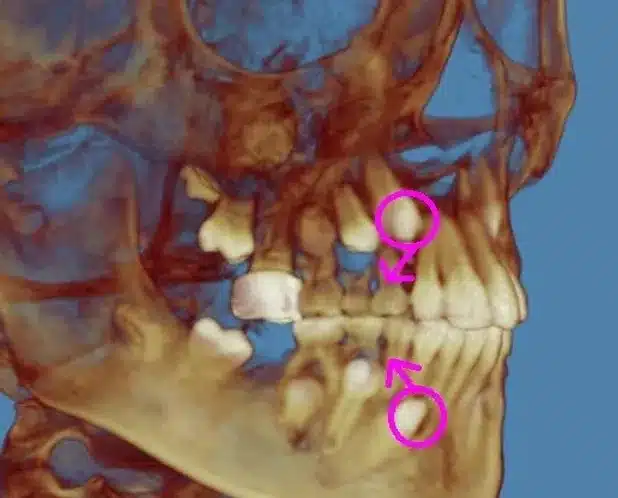
Patient’s first visit: This child’s adult canine teeth (circled) are headed in the wrong direction. Sometimes we call this “off course”. Their correct path is indicated by arrow.
After the exposure: Baby teeth have been taken out, and exposure treatment has been carried out – canines have been guided back ‘on course’, and are close to their correct positions in the dental arches.
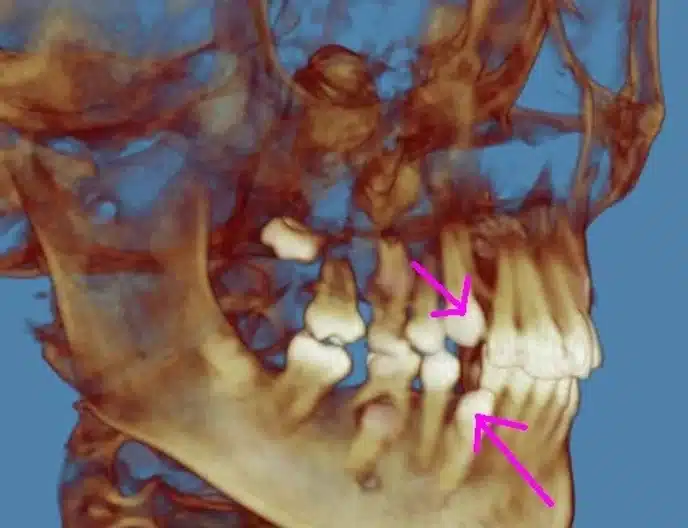
Review: Canines have continued moving into alignment – they are now well-positioned for fine-tune straightening with the rest of the teeth.

Nearly done! Nearly time for braces off, canine positions finalised along with the rest of the teeth.
Are there risks during exposure treatment?
Like all surgeries, even when carried out by a qualified, experienced professional, exposure surgery carries some risks. Prior to proceeding with the exposure treatment, you’ll meet with a specialist to discuss the procedure. Your periodontist or oral surgeon will assess your own individual circumstances and will explain the associated risks so that you are able to make an informed decision regarding whether or not the procedure may be right for you or your child.
You should be aware that there is a possibility that the exposed tooth will not respond to treatment. In this instance, your Orthodontist will devise an alternative plan. The likelihood of this happening is generally small.
What are the benefits?
Correcting teeth before they are significantly off-course usually leads to faster, easier treatment. In some cases an untreated tooth will (1) fail to come through – or (2) come through so far from its intended position that tooth extraction is the only good option.
What can I expect?
Patients can generally expect some localised discomfort. Your gum specialist will provide more information and guidance at your consultation appointment.
If you think you or your child may benefit from an orthodontic assessment, feel free to book a Free* Assessment with us today!