
People often think an overbite is just a cosmetic issue, often linked to a ‘buck teeth’ appearance. However, not all overbites are obvious. In some cases, your teeth may be crowded or bite deeply over the bottom teeth rather than sticking out. Often, people don’t realise they have an overbite until a qualified orthodontist points it out – sometimes to their surprise, especially if it’s severe.
What Is an Overbite?
An overbite refers to how much the upper front teeth overlap the lower front teeth. A slight overbite is normal, but when the overlap is excessive, it can lead to functional issues.
In a normal bite:
- The top teeth should sit ahead of the lower teeth by about 2mm (horizontal overbite). Orthodontists tend to call this the ‘overjet’.
- The upper front teeth should cover about 30% of the lower front teeth (vertical overbite).
. This vertical measurement what orthodontists usually mean when they describe the amount of ‘overbite’.
Increased overjets and overbites are often seen together, and often have common underlying causes (e.g., the lower jaw growth pattern).
While it may not seem like a big deal, an untreated deep overbite can cause tooth wear, sensitivity, enamel loss, and jaw discomfort.
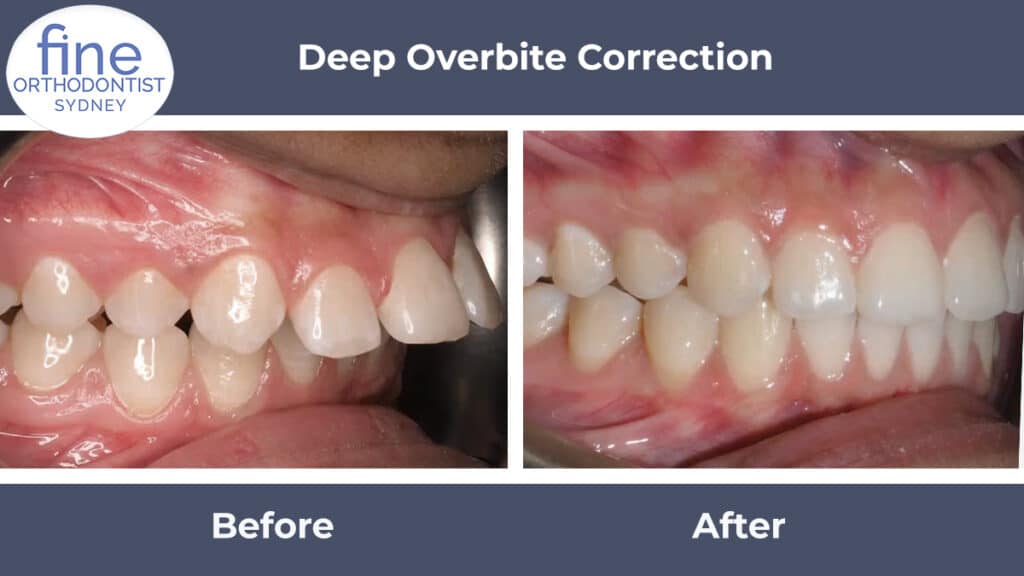
Notes: Class II malocclusion. Invisalign® upper and lower 28 months. This product is not available for purchase by the general public. Always follow the directions for use. Patient also had an adjunctive surgical procedure (beneslider appliance for anchorage). It is important to remember that all surgeries involve risk, even when carried out by an appropriately qualified, experienced professional. Outcomes shown are only relevant for this patient and do not necessarily reflect the results other patients may experience. Results will vary depending on patients’ individual circumstances.
Here’s why:
1. Lower Front Teeth Get Stuck
In deep overbites, the lower front teeth can become ‘trapped’ behind the upper front teeth, preventing natural movement when chewing or speaking. Instead, they may rub against the back of the upper teeth or even the roof of the mouth. Over time, this constant pressure wears down the lower teeth, even if they don’t seem to be hitting the upper ones directly.
2. Excess Pressure on the Teeth
A deep overbite can put too much force on certain teeth, leading to cracks, chips, or thinning enamel. This can result in tooth sensitivity and impact the longevity of your teeth. The gums and palate may also be affected if they are being subject to incorrect, excessive forces over time.
3. Teeth Grinding and Clenching Make It Worse
Many people unknowingly grind or clench their teeth at night. Many of us develop this habit at some stage during our lives. For those with a deep overbite, this speeds up damage such as excessive tooth wear, and increases the likelihood of tooth fracture.
4. Damage Can Accelerate Quickly
Once the protective enamel wears down, the softer dentin underneath is exposed. Dentin erodes much faster than enamel, causing teeth to look shorter, feel more sensitive, and wear out quickly. Even patients who are closely monitored can experience sudden worsening. Preventing this with orthodontic treatment is far easier than trying to restore damaged teeth later.
How Invisalign® and Braces Can Help
The good news?
In the majority of cases, either Invisalign® or braces can be considered to correct an overbite, helping to improve bite function and reduce tooth wear and trauma.
Orthodontic treatment can:
✔ Align the teeth properly to distribute bite forces more evenly.
✔ Improve jaw function and comfort.
✔ Help maintain long-term dental health.
✔ Reduce the need for costly, difficult-to-maintain restorations.
✔ Correct cosmetic concerns like buck teeth, excessive gum display, or teeth that are hidden under the lips when smiling.
Can Invisalign® Correct My Overbite?
This depends on your specific case. Invisalign® can correct many types of overbites, but the best approach varies based on your bite and treatment goals. A qualified orthodontist will assess whether Invisalign® is suitable for you.
Note: This product is not available for purchase by the general public. Always follow the directions for use.
Do Braces Always Work for Overbite Correction?
Braces are a powerful option for correcting overbites. However, in certain, severe cases or when patients want significant changes to their facial profile, adult orthodontic patients may wish to consider orthognathic (jaw) surgery combined with orthodontic treatment.
You may like to check out our before and after jaw surgery gallery.
What About Growing Children?
Children have more options for overjet and overbite correction because orthodontists can influence jaw growth to guide better alignment. Treatments like bite jumpers can help reposition the jaws while the child is still growing.
What’s the Best Overbite Treatment for Me or My Child?
Overbite correction isn’t a one-size-fits-all approach. The best treatment depends on factors like jaw structure, tooth alignment, and facial aesthetics.
The great news? We offer free* orthodontic assessments to assess your case and discuss the best options for you, if treatment is indicated. You’ll get a run-through of suitable treatment options along with a no-obligation quote.
Note: For the vast majority of patients, orthodontic treatment is an elective procedure. One possible alternative to orthodontic treatment is no treatment at all. Orthodontic treatment may not be suitable for you.